

The most distant lensing cluster reveals a dark matter surprise
Over 10 billion years in the past, an ultra-massive galaxy cluster lenses objects behind it. That has big implications for dark matter.


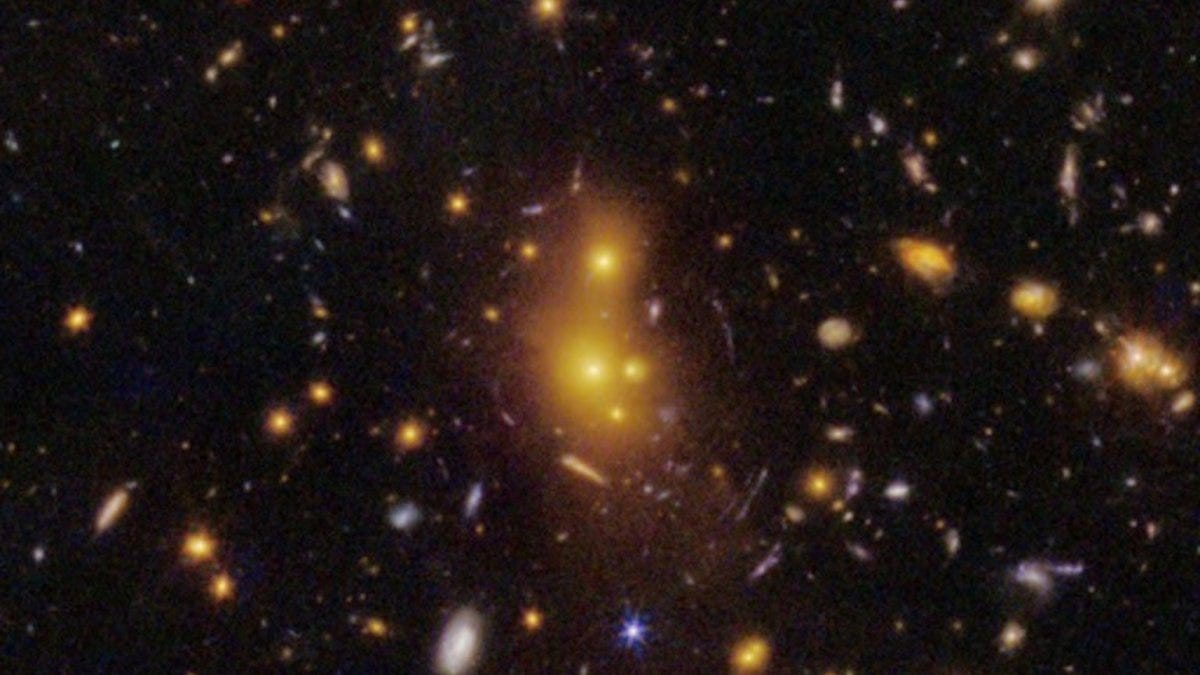
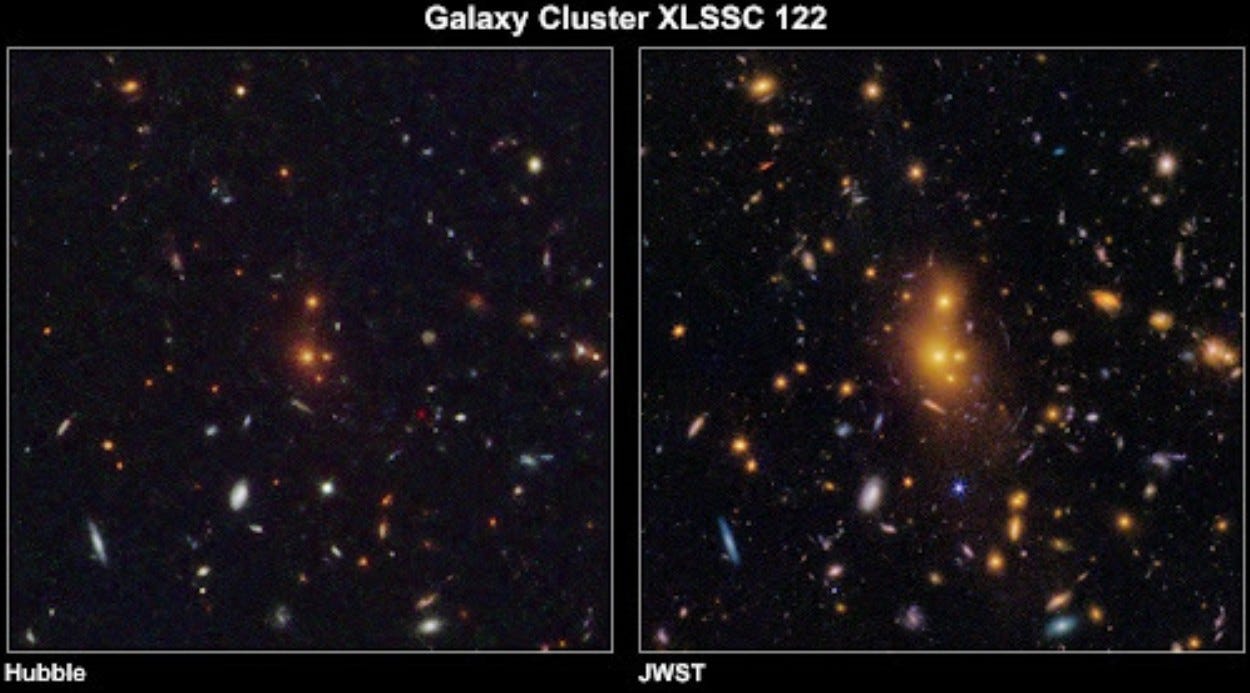
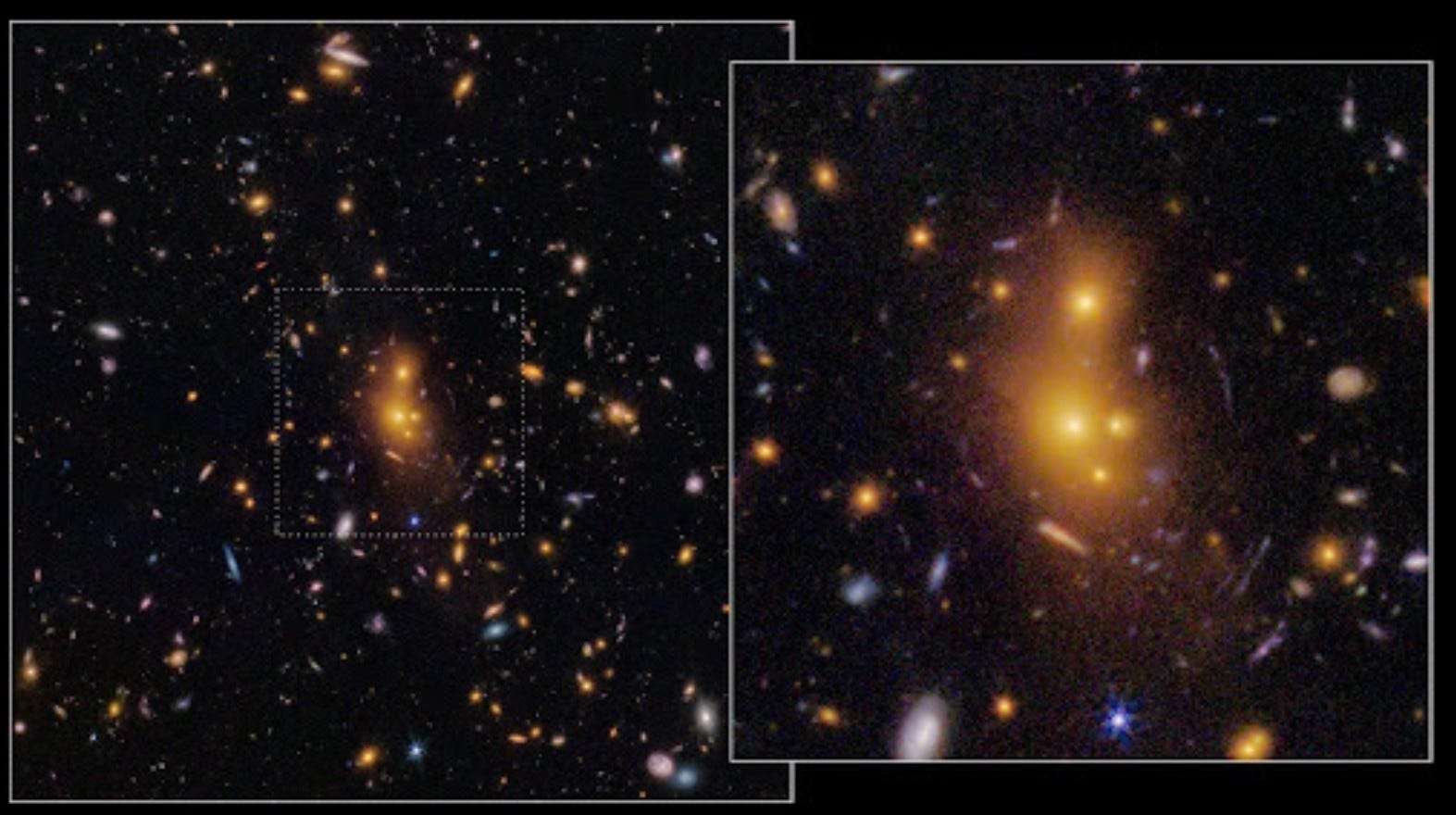
All across the Universe, the one force that matters the most on cosmic scales is gravitation. From a nearly perfectly uniform past, initially tiny imperfections — just a fraction-of-a-percent denser than average — eventually grew into the massive cosmic structures we see today: star clusters, galaxies, groups of galaxies, and even stupendously large galaxy clusters. While one such early cluster, XLSSC 122, had been previously imaged and identified with the Hubble Space Telescope, the extraordinary vision of the James Webb Space Telescope (JWST) revealed so much more, including the unexpected.
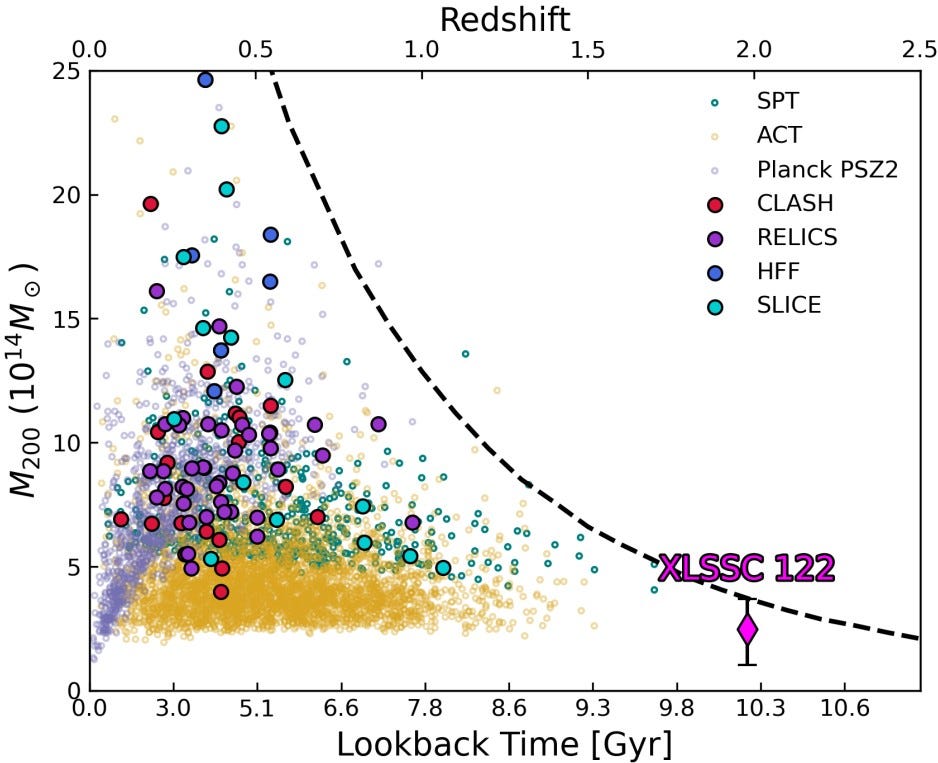
Sure, it’s an incredibly massive cluster: weighing in at about 300 trillion solar masses, or hundreds of times the mass of the Milky Way galaxy. In addition, it’s very far away: possessing a redshift of z = 1.98, which corresponds to a time just 3.3 billion years after the Big Bang, or 10.5 billion years ago. This big, organized, evolved object was already mature, and was mature at a time when most other clusters were still actively forming.
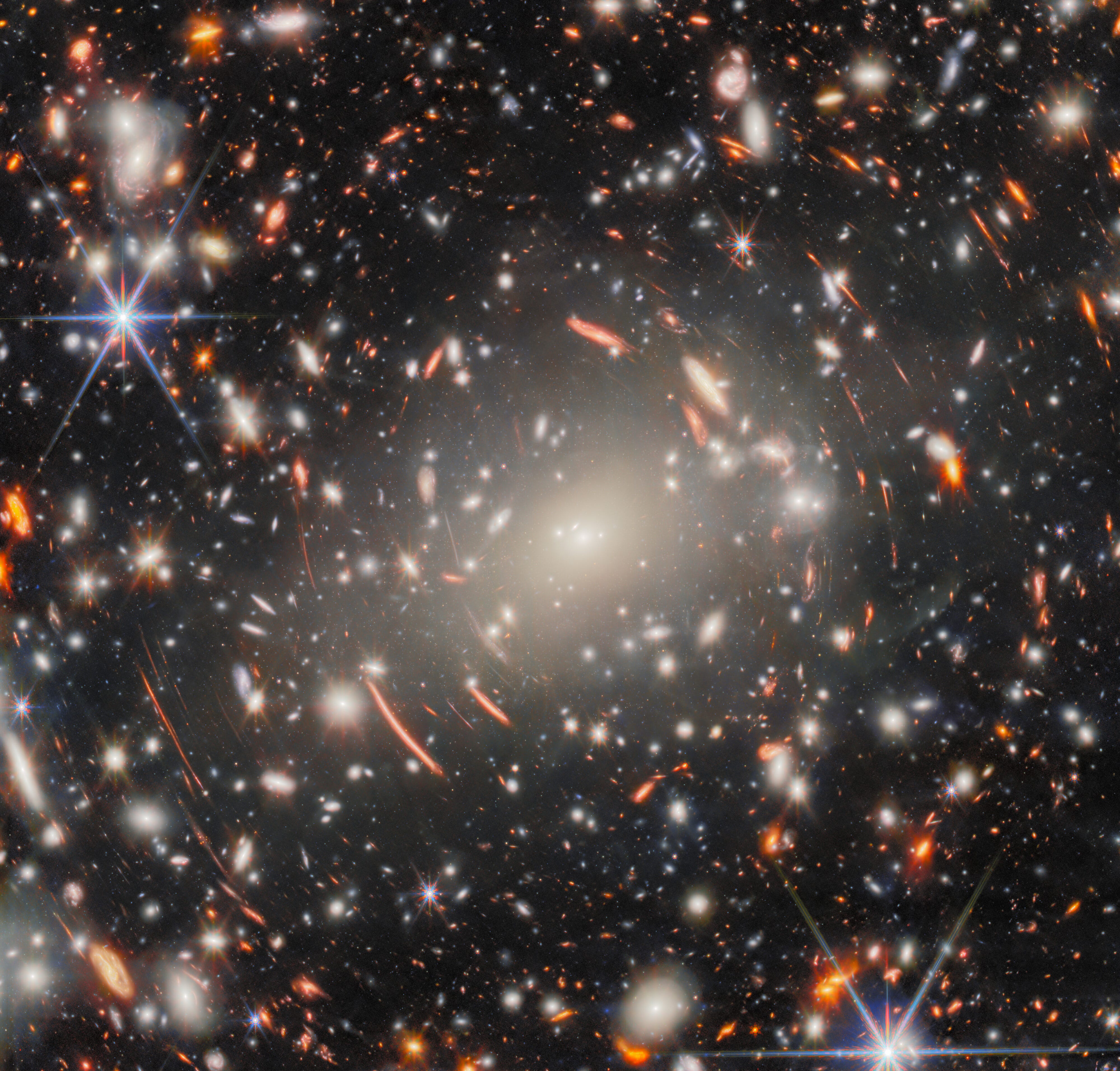
But with JWST’s power, scientists were also able to identify streaking blue arcs near the cluster’s center: evidence of strong gravitational lensing. This makes it one of the farthest gravitational lenses ever discovered (along with this distant lensing galaxy), and the most distant galaxy cluster seen to exhibit strong lensing. That encoded a plethora of valuable information about the cluster’s mass distribution, with severe implications for dark matter. Here’s what astronomers found inside.
The cosmic story for how a cluster like this comes to be always has the same standard components to it, even if the details such as timescales and masses vary. That story is known as hierarchical structure formation, which involves the following steps.
First, the Universe gets seeded with a spectrum of initial fluctuations on all scales, where the initial overdensities typically provide the seeds that will, at late times, grow into massive structures.
After neutral atoms form, those seeds begin growing, drawing matter in from their surroundings, leading first on very small scales (tens-to-thousands of light-years) to the formation of the earliest stars and star clusters, or even to early black holes.
Next, as more time passes, these early, massive structures grow via accretion (where surrounding matter falls into them) and mergers (where various clumps gravitationally join together), leading to large galaxies and swarms of small galaxies: the first galactic groups.
Then, at even later times, seemingly independent galaxies and galactic groups get drawn together by gravity, forming the earliest galaxy protoclusters, with some of the most precocious examples spotted less than a billion years after the Big Bang.
And finally, much later on, typically no earlier than 3 billion years after the Big Bang, the earliest mature galaxy clusters emerge, with hundreds of trillions of solar masses and many large, massive galaxies inside of them.
The JWST has been revolutionary in revealing not only unprecedented examples of most of these stages, but in showcasing details about these objects at these stages that no other observatory can presently reveal.
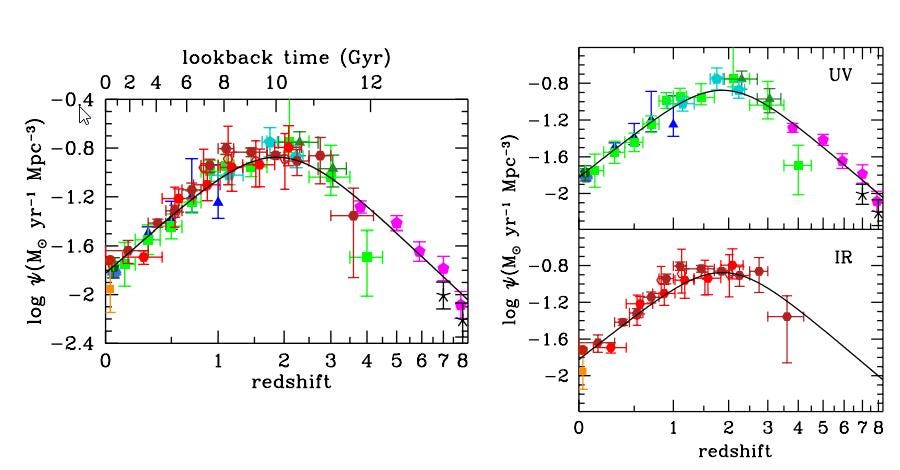
In particular, the time period from about 3 billion years after the Big Bang until about 5 billion years after the Big Bang represents a very special epoch in cosmic history: a time period known as cosmic noon. If you were to track the Universe’s star-formation history over time, you’d find that:
initially, the rate was zero,
then it gradually and steadily rose (cosmic morning),
until it reached a peak (cosmic noon),
and then has steadily declined (cosmic evening/sunset) ever since.

Today’s star-formation rate is estimated to only be about 3% of what it was at its peak at cosmic noon, indicating that the vast majority of stars that will ever form have already formed, and did so long ago on top of that.
However, by looking back at the distant objects we see at those earlier times, we can indeed learn how our Universe grew up, and in turn, how it led to the modern cosmos we’re familiar with today. And in the case of XLSSC 122, it’s a remarkable system for a number of reasons. Perhaps most importantly, for its time in cosmic history, 10.5 billion years ago (or 3.3 billion years after the Big Bang), it’s the most massive galaxy cluster known so far. Although plenty of more massive galaxy clusters appear later on, this one is special because of how massive, centrally concentrated, and “grown up” it looks right at the time that the first “grown up” galaxy clusters ought to be appearing.
There’s a second reason that large, massive collections of matter are so useful for studying our cosmic past: with so much material collected in such a small volume of space, these masses can lead to gravitational lensing of the objects located behind them, but along the same line-of-sight from our perspective. Due to the nature of spacetime, and in agreement with the predictions of Einstein’s general relativity, the presence of a large-enough, compact-enough mass in space acts like a lens in two important ways.
Through the overall effect of having that mass located in space, the background objects whose light passes near or through that massive region of space will appear distorted: with their shapes stretched along circles surrounding that mass. This is the effect of weak gravitational lensing.
And when individual background objects happen to line up with those regions where the magnification and distortion effects are maximal, those background objects can be severely stretched, distorted, and magnified, often into arcs, rings, and multiple images. This is the effect of strong gravitational lensing.
While weak gravitational lensing is a vital tool for mapping out the mass distribution of galaxy clusters, including for XLSSC 122, it’s the strong lensing features that can probe the mass distribution most precisely at the cluster’s center: where the mass densities are highest.
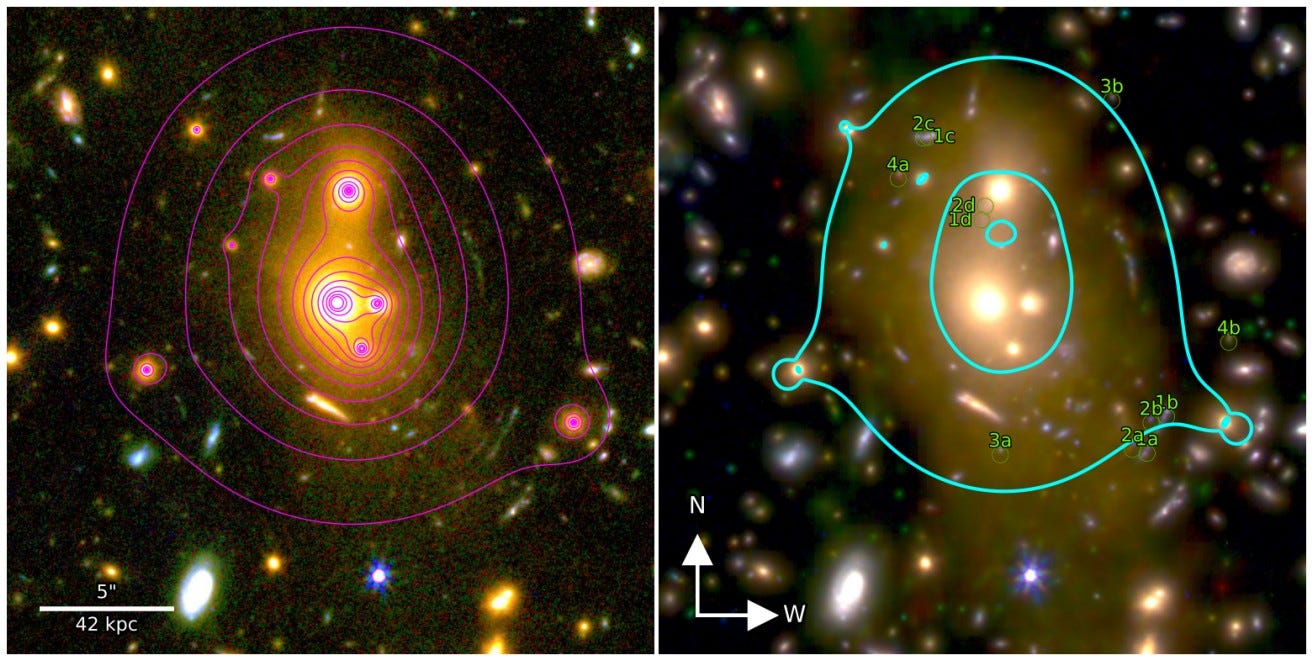
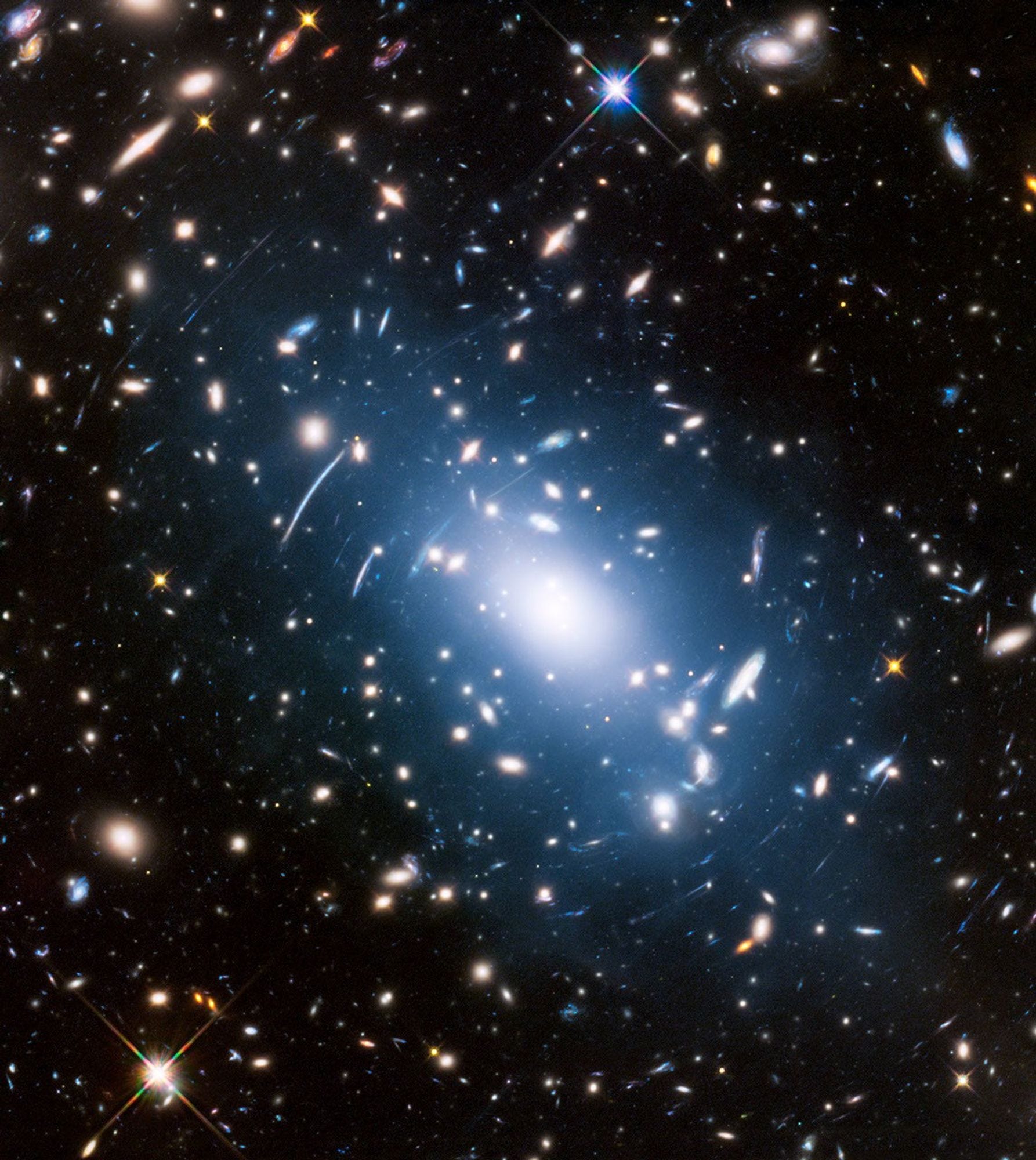
Here in the late-time Universe, one of the things we’ve discovered about galaxy clusters, as you can see above, is that there isn’t just the masses of the individual galaxies — stars, gas, dust, plasmas, black holes, and enormous dark matter halos — that contributes, but a broad, smooth distribution of mass that dominates the entire cluster. That mass cannot be normal matter, but rather is dark matter, and it outweighs all of the normal matter combined by about a 5-to-1 ratio.
Initially, it was gravitational lensing, and mostly weak gravitational lensing at that, which allowed us to map out the masses of galaxy clusters in the nearby Universe. This method is very powerful because of how often it can be leveraged for galaxy clusters. However, it’s limited in its power. While it’s generally quite sensitive to the cluster’s overall mass, it’s less able to probe cluster substructure or the overall mass density (and variations in that density) toward the cluster’s center.
Another method that’s grown more powerful and ubiquitous in recent years is to use stars that have been torn out of their parent galaxies to trace the dark matter distribution in the intracluster medium: the space within galaxy clusters that lies between the individual galaxies. This intracluster light can augment lensing studies and provide key information about the dark matter structure and distribution inside of these massive galaxy clusters.
What we generally find, at least here in the late-time Universe, is a bit of a puzzle. While simulations — relying on a single-species model of dark matter that’s both cold and collisionless, but that does have mass and interacts gravitationally — generically predict that dark matter should be:
of low density on the outskirts,
should increase as you move toward the center,
should “turn over” to increase more slowly within a certain distance,
and then should lead to a cuspy-profile, peaked in dark matter density near the center itself,
observations don’t quite support that picture. The first three steps appear to align with observations fairly well, but then, in the innermost regions, it’s as though the density doesn’t rise anymore and there is no cusp.
Instead, the density toward the central regions appears to remain constant or, in some cases, to even decrease: as though something has caused the expected dark matter to be removed from those regions. Many theoretical ideas have been proposed to explain this phenomenon, including self-interacting dark matter, two (or more) species of dark matter particles instead of just one, or the very clever idea of dynamical dark matter heating (originally applied to individual galaxies): where gravitational interactions between normal matter and dark matter cause the dark matter to gain kinetic energy and be removed from the cluster’s center.
However, by being able to leverage strong gravitational lensing signals from a young, early, but massive-and-evolved galaxy cluster, we now have a new laboratory to observationally probe. The older Hubble image of XLSSC 122 was unable to reveal any signatures of strong lensing, but with JWST’s high-quality, high-resolution, and longer wavelength imaging, those characteristic arcs prominently appeared, in blue, around not only the galaxy cluster itself, but directly around the brightest galaxy found at the center of the cluster. From those arcs, the scientists were then able to:
construct a rudimentary mass model for the cluster’s central region,
finding an extreme central concentration of dark matter,
and then using that mass model to predict the location, based on geometry, of any fainter radial arcs that might be present.
Because it’s just a geometry-based calculation, it’s as though astronomers now had an invisible “arrow” that screamed out, “look here” to them. When they did, they indeed found the radial arc very close to that bright galaxy’s center, and that arc’s visual properties then empowered the astronomers to construct an even more precise mass map of the cluster’s central region.
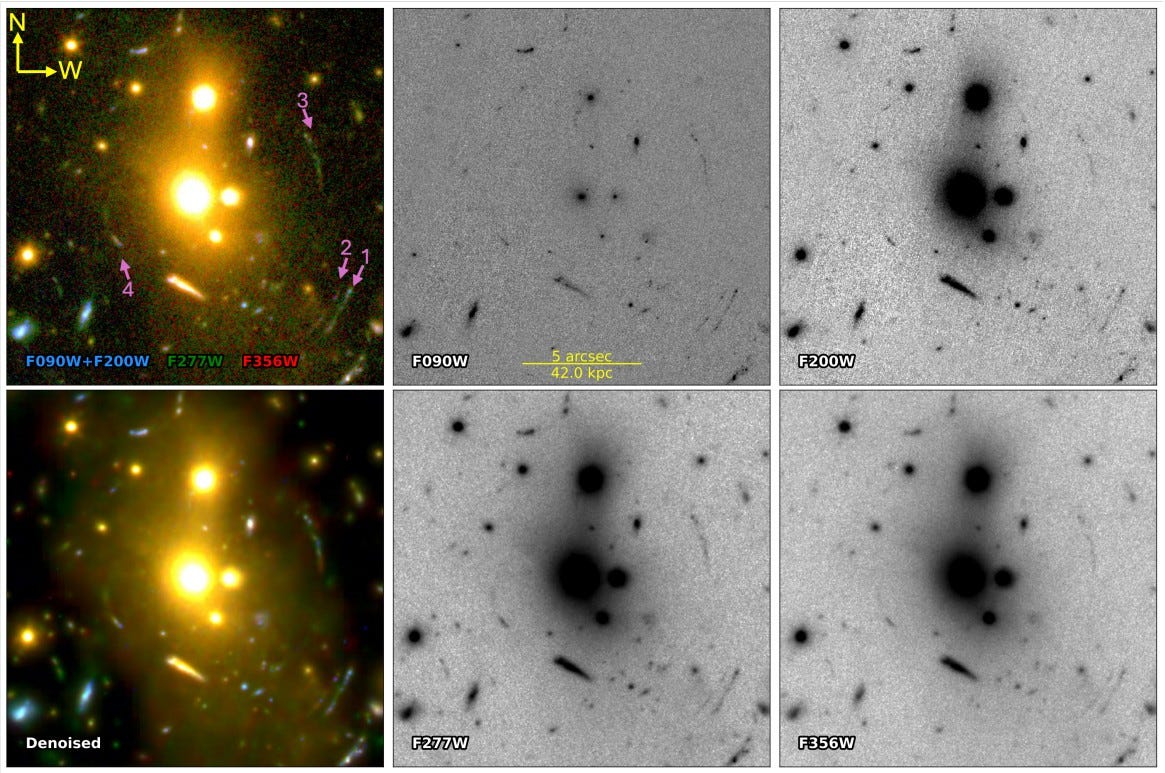
The multiwavelength data from JWST helped identify the individual arcing features from background galaxies, and also allowed astronomers to quantify the intracluster starlight that traces the dark matter near the central regions, with both sources of data combining to help construct the most accurate mass map — including dark matter — of this cluster ever. They furthermore were able to show that this isn’t just an isolated galaxy cluster, but rather a galaxy cluster that’s in the process of actively experiencing a merger between two or more components: a conclusion bolstered by multiwavelength (X-ray, microwave, and radio) data.
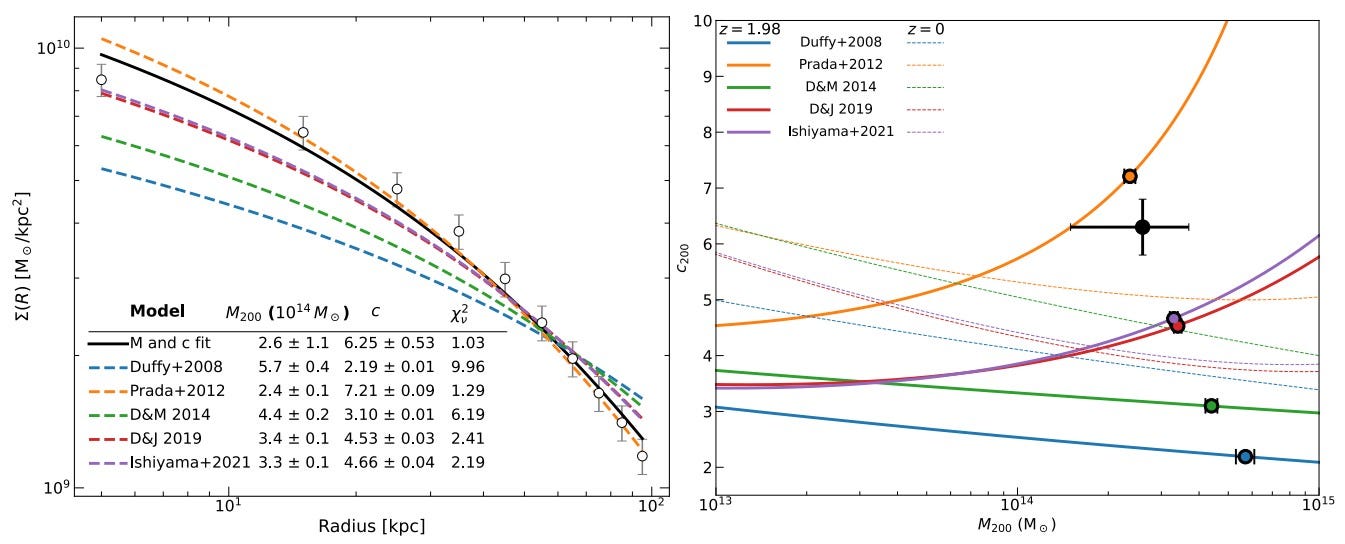
What’s most interesting about this cluster is that the dark matter is unusually heavily concentrated toward the center: higher than modern day, late-time clusters, higher than other galaxy clusters caught in the act of merging, and higher even than simulations predict. The central density of mass is very high, and this is based off of not only a variety of lines of evidence that support such a conclusion, but are bolstered by the exquisite strong lensing data, available only with the advanced imaging capabilities of JWST and its NIRCam instrument.
This is the Universe as seen at its most extreme in an impressive number of ways.
It represents the earliest, most distant galaxy cluster ever observed to be behaving as a strong gravitational lens, and is a candidate for the most distant object, period, that acts as a strong lens.
It’s also the most massive galaxy cluster for its age in the Universe ever spotted, with hundreds of trillions of solar masses (estimated: 300 trillion) at a time when the Universe was under a quarter of its current age, just 3.3 billion years old.
It has a more severe concentration of dark matter at its center than any other massive galaxy cluster ever found. While that concentration is expected to evolve as the Universe evolves (note the difference between the solid lines and the dotted lines on the graph at the above-right), the actual, observed concentration is really at the upper limits, even exceeding them in places, of what simulations predict.
And finally, it represents the earliest example of intracluster light ever detected within a galaxy cluster: an incredibly sensitive tracer of the global dark matter distribution inside of galaxy clusters.
When you fold in the weak lensing data, it allows for an accurate, inside-to-outside mass map of the extended cluster complex, demonstrating that it is, in fact, merging, with the constituent galaxies still in the process of coming together.
According to the lead author of the newest study, Kyle Finner, who presented this work at the American Astronomical Society’s 248th meeting in June of 2026 in Pasadena, CA, this really is the start a revolution in astronomy: one that’s just beginning to come to fruition with the new imaging of this cluster by JWST.
“Before JWST, we couldn’t do this level of science in the early, distant Universe. Strong lensing is a way to measure the dark matter without actually seeing the dark matter… it gives us a sensitive probe of our cosmological models. Weak gravitational lensing can constrain mass much further out, so you can get a better picture of the surrounding cluster area. [And then,] in this cluster, the intracluster light essentially traces the dark matter. That light tells us that the cluster is in a merging state. It’s still early in the JWST era, and if we can start to get data on tens or hundreds of these types of objects at this stage in the universe, then we can really start putting our cosmological models to the test.”
This is the most important part: JWST and Hubble, over all the time they’ve been operational, have surveyed less than 1% of the total sky combined. As we not only peer into the Universe deeply, but with wide-field and multiwavelength instruments, we’re bound to uncover a whole lot more examples of what are presently rare objects like XLSSC 122.
If just a few dozen, or even a few hundred, clusters like this are identified — massive galaxy clusters at early times in cosmic history — we’ll be well-equipped to not only learn how the Universe grows up in many regards, but to learn about its implications for dark matter, structure formation, and galaxy cluster collisions. When you find one extraordinary example when you only look at a tiny fraction of the sky, you can count on other examples being out there. If clusters like this one turn out to be common, we just may be on the verge of discovering a whole host of profound information about what composes our Universe at a fundamental level.

Ethan Siegel, Ph.D., is an award-winning theoretical astrophysicist who's been writing Starts With a Bang since 2008. You can follow him on Twitter @StartsWithABang.
Get more from Big Think:
Big Think | Mini Philosophy | Big Think Books | Big Think Business
The universe acts as a 100% closed system for mass, matter, kinetic energy and all kinds of electromagnetic forms of radiation. Within that closed system the universe endlessly passes the very same overall energy-neutral cycle of now 29 steps. Documents G6, G7, G8, G12 www.uiterwijkwinkel.eu . Step 29 100% equals step 1 and start of the next very same cycle.
Our universe starts and ends extremely cold with a gigantic black hole/ Little Bang. That Little Bang black hole fell apart into an equivalent number of protons/ electrons expanding as mono-layers p/e 0,7c during the next 10 - 15 billion of years without atoms, gravity, gravitional energy, temperature and physically/ chemically forces.
After 10 - 15 billion years every proton catches its own electron and exclusively the H atom/ H2 molecule can be formed.
The Big Bangs and start of the galaxies (some 30 - 40 billion years later and some 30 - 40 billion years ago) and same moment creation of their gigantic central blackholes (millions - billions of Sun-gravity-equivalents/ SGE's) are already step 16 in this cycle of the universe of now 29 steps. Now we are in the beginning step 23.
The now ongoing cycle thus started already some 75 - 85 billion of years ago. One complete cycle requires some 35 - 50 trillion (10E12) of years.
This endlessly ongoing cycle can be modelled mathematical and by AI quantified as 29 separate models for each step in this cycle of the universe that way the latest step (now 29) equals 100% step 1.