

Yes, interstellar comet 3I/ATLAS is older than the Solar System
Interstellar comet 3I/ATLAS has an ancient age, but not for the reason most commonly touted. These three lines of evidence are far stronger.


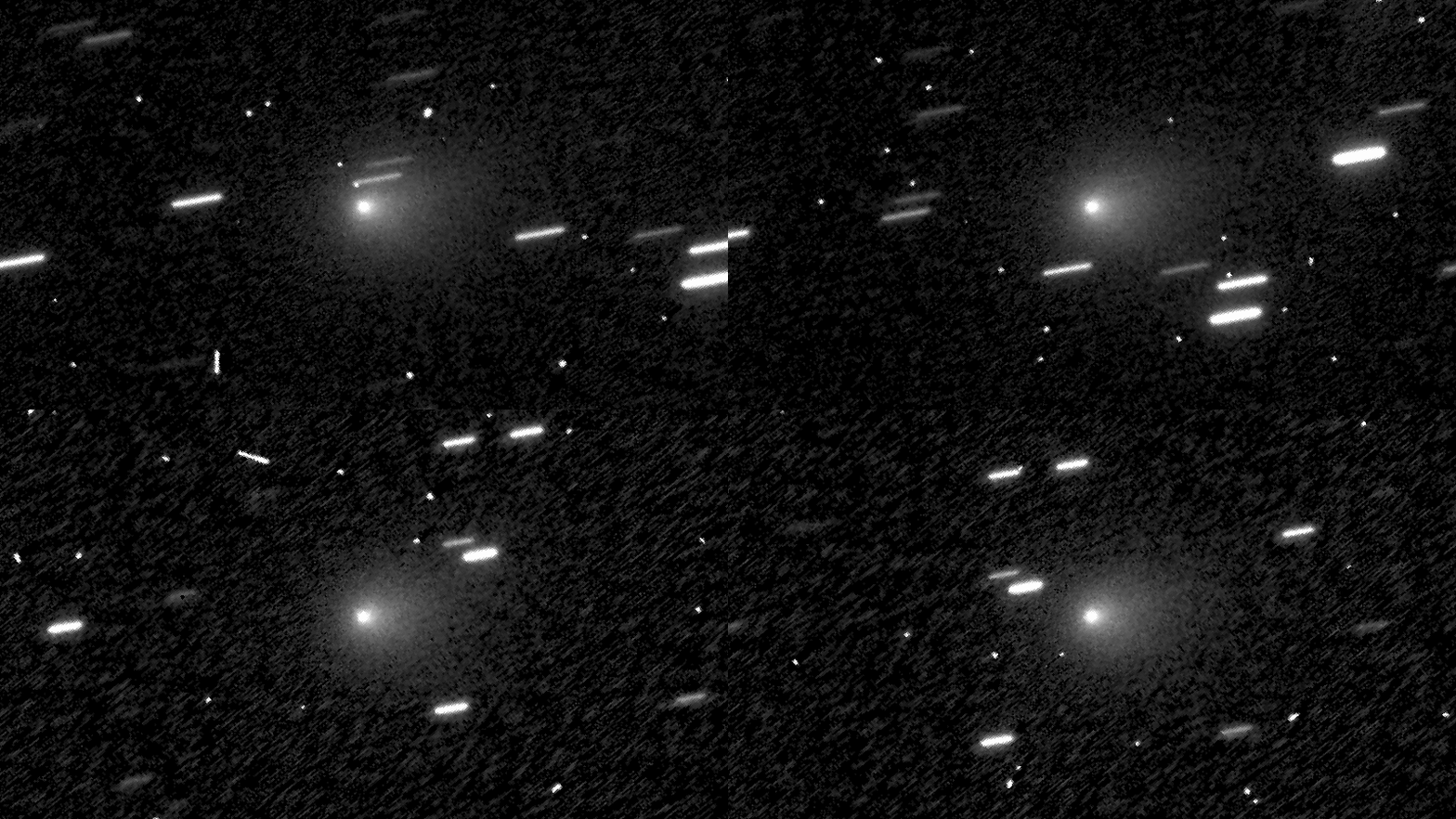

Here in our Solar System, nearly everything we encounter was indeed native to our Solar System itself. The Sun, planets, and moons all originated from the same pre-solar nebula. The objects in the asteroid belt, Kuiper belt, and Oort cloud have that same primordial origin: formed from the same pre-solar nebula that gave rise to our Sun, the planets, and the moons. When we observe them — whether in their original locations or because a gravitational encounter has hurled them into the inner Solar System — we can observe their properties, including their colorations and their elemental contents, and determine that yes, we’re all made out of the same primordial “stuff,” originally.
But that’s not the case for something that originates outside of our Solar System. While we may have begun forming roughly where we are now, around 26-27,000 light-years away from the galactic center some 4.6 billion years ago, the galaxy and the grander Universe have been forming stars, stellar systems, and other rocky, metallic, and icy bodies all throughout cosmic history. As we travel through space, so do all of the other components of the cosmos, and occasionally, there’s a profound encounter.
When interstellar comet 3I/ATLAS plunged through our Solar System in 2025 and departed here in 2026, it wasn’t just the third object of interstellar origin ever discovered. It was the fastest, most inclined, and also the most ancient object ever directly observed to enter our vicinity. Here’s how we know that it truly is older than our Solar System.
To determine that it originated from outside the Solar System is relatively easy: orbital mechanics alone can get us there. When you observe an object that originates from within the Solar System, its velocity is determined by three things:
its initial distance from the Sun,
the gravitational kick it received from whatever object passed by it to change its orbit,
and then the gravitational influence of the bodies in the Solar System (primarily the Sun) itself, as gravitational potential energy gets converted into kinetic energy, or the energy of motion.
By observing an object’s position and motion over time, we can trace out its orbit, and identify where in our own Solar System it originated.

Objects originating from the Kuiper belt move faster, when they achieve the same distance from the Sun, than objects originating from the asteroid belt. The reason is simple: by starting off farther away from the Sun, a greater amount of gravitational potential energy gets converted into kinetic energy when they get hurled into the inner Solar System. Initially, asteroids in stable orbits move at around 18 km/s relative to the Sun from within the asteroid belt; Kuiper belt objects in stable orbits move at around 3-5 km/s relative to the Sun, and objects within the Oort cloud move at around 0-1 km/s relative to the Sun.
They can then receive gravitational kicks — from Jupiter, Neptune, or a smaller body — and gain speed as they approach the Sun. However, comet 3I/ATLAS was determined to be moving at a whopping 58 km/s when it first entered our Solar System: far too fast to be explained by any gravitational kick.
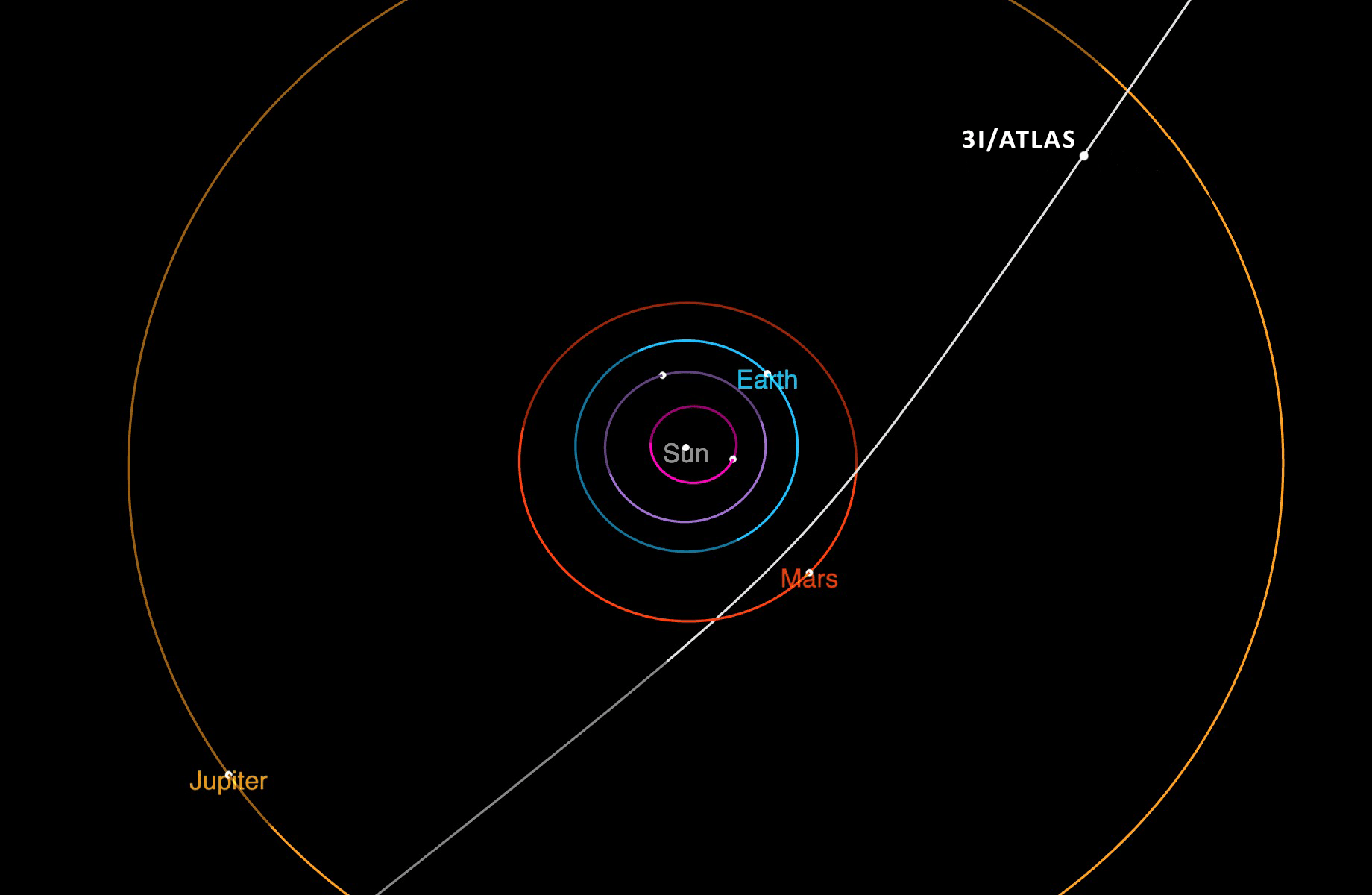
That key piece of information — what physicists call its “velocity at infinity,” or its initial velocity upon entering the Solar System — was enough to determine that yes, this object was indeed of interstellar origin. An encounter with Neptune might add up to 5 km/s to an object’s speed; an encounter with Jupiter might add up to 26 km/s. Comet 3I/ATLAS encountered neither of them, but still moved at an incredible 58 km/s before even entering the Solar System, while reaching a maximum speed of 68 km/s at perihelion, cutting inside of Mars’s orbit at its closest approach to the Sun: achieved on October 29, 2025.
In fact, 3I/ATLAS entered almost completely reversed to the directions that planets orbit around the Sun, and it has a severely hyperbolic trajectory. Of the three interstellar objects known, 3I/ATLAS has the greatest velocity at infinity (or hyperbolic excess velocity) of them all, meaning that it hurtled through interstellar space, and encountered our Solar System, at greater speeds than either ‘Oumuamua or Borisov. Initial studies traced its orbit back to the thick disk of the Milky Way, toward the galactic center but slightly out of the plane, and suggested — based on the stars in that location — an age for 3I/ATLAS that was older than the Solar System: around 7 billion years of age.
However, that turns out to be extremely flimsy evidence for determining the age of this — or any — object of interstellar origin. When you trace back an object’s trajectory through interstellar space, that doesn’t necessarily tell you meaningful information about its ultimate origin. All it tells you is what the object’s trajectory can be inferred to be since its last major gravitational encounter. After all, in the aftermath of encountering our own Solar System, 3I/ATLAS’s trajectory is now completely different, and someone who didn’t know any better would infer that it originated, with a remarkably large velocity, from our own Solar System.
In other words, 3I/ATLAS’s trajectory tells us that at some point, it either arose from or encountered a star system in or near the Milky Way’s thick disk, but that could have been:
its system of origin,
the first system it encountered (and was gravitationally kicked by) after originating from elsewhere,
or only the most recent system it encountered (after one or more prior encounters) after originating from elsewhere in the galaxy.
Simply being able to trace its orbit back to a location tens of thousands of light-years away doesn’t uniquely determine its point of origin, nor does it determine its age. Dynamical effects could have altered its orbit significantly since its departure from its original, parent system. However, other physical and chemical properties do allow us to make inferences about how and when this object arose, and fortunately, we’ve been able to measure three critical ones that do show us that 3I/ATLAS is likely significantly older than the Solar System.
1.) Color
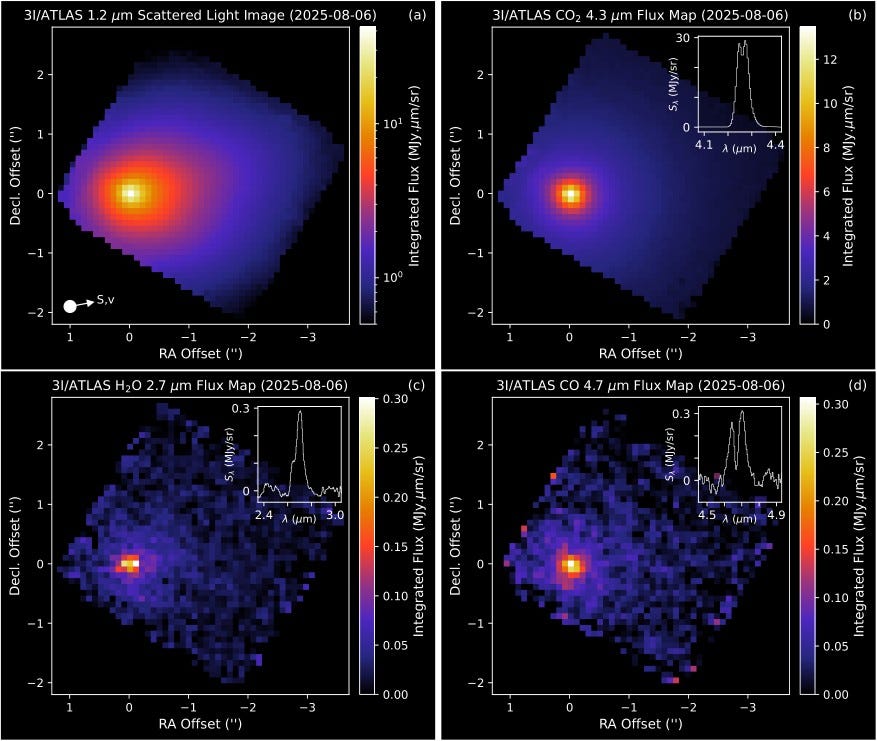
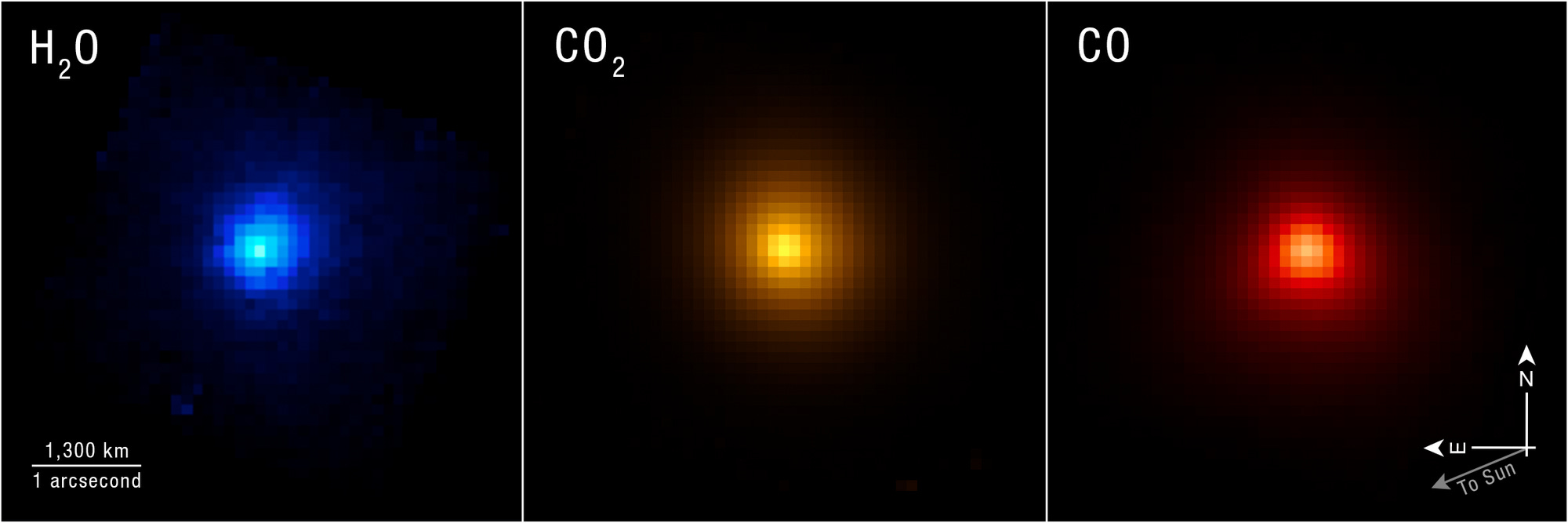
The first key property is the color of the interstellar interloper 3I/ATLAS. Sure, you might be used to seeing it as green — the color of the diatomic carbon that its coma emitted when it was near to the Sun — but that’s only the color of its excited volatiles being expelled. Cyanide and other molecules were also detected as part of the object’s outgassing, but it’s not the evaporating volatiles that tell you about an object traveling through the Solar System’s age. Rather, it’s the color of the nucleus itself that we need to examine.
Here within our Solar System, the effects of the Sun — including its magnetic properties, its wind, and the solar bubble carved by its radiation — help keep the asteroid belt and Kuiper belt objects isolated from interstellar cosmic rays (i.e., particles) in a way that Oort cloud objects, lying well beyond the heliopause, are not isolated from them. As a result, what we see as “active comets” are in general much bluer in color than the “inactive comets” which are continuously weathered by those cosmic rays. Based on the severely reddened color of 3I/ATLAS, we can infer that it likely has a relatively large age: large compared even to the Oort cloud objects in our Solar System.
That’s still indirect evidence, but it’s much stronger evidence than the trajectory of 3I/ATLAS provides for its old age. However, two newer pieces of evidence, just published in a new study in the journal Nature, are even stronger.

2.) Deuterium
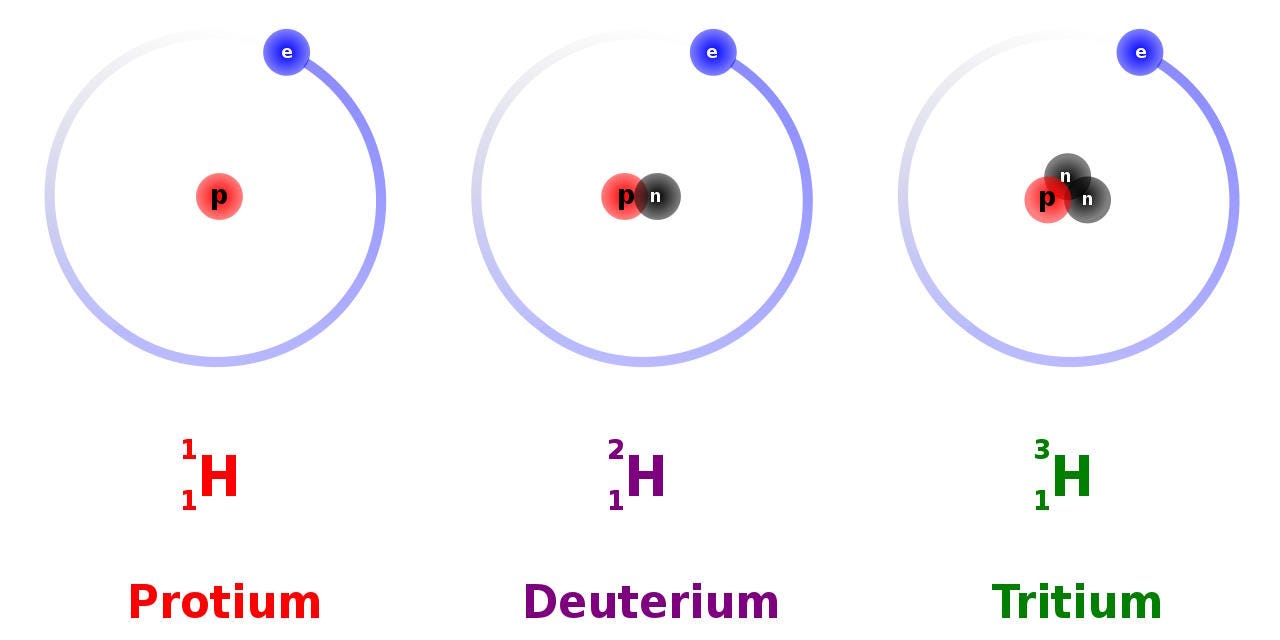
Here in our Universe, hydrogen atoms come in three different species:
protium, also known as plain old hydrogen, with just a single proton in its nucleus,
deuterium, or “heavy hydrogen,” with a proton and a neutron in its nucleus,
and tritium, or “doubly heavy hydrogen,” which is unstable against radioactive decay (beta decaying to helium-3 with a half-life of around 12 years), containing a proton and two neutrons in its nucleus.
Deuterium is both created and destroyed in stars, as it is a relatively fragile atomic nucleus: capable of being blasted apart at temperatures typically achieved in stellar interiors.
Although deuterium was created in significant quantities early on in the hot Big Bang (during Big Bang Nucleosynthesis), its abundance actually decreases over time here in the galaxy. Therefore, if you measure the abundance of deuterium, relative to hydrogen, in an object of interstellar origin and compare it to the deuterium-to-hydrogen ratio found in comets of Solar System origin, you can determine whether the object is younger, older, or around the same age as our Solar System.
While less than 0.1% (and as little as 0.01%) of the hydrogen content in Solar System comets is made of heavy hydrogen, a whopping 0.98% — about a factor of 30-50 greater than typical Solar System values — of the hydrogen content in 3I/ATLAS is deuterium.
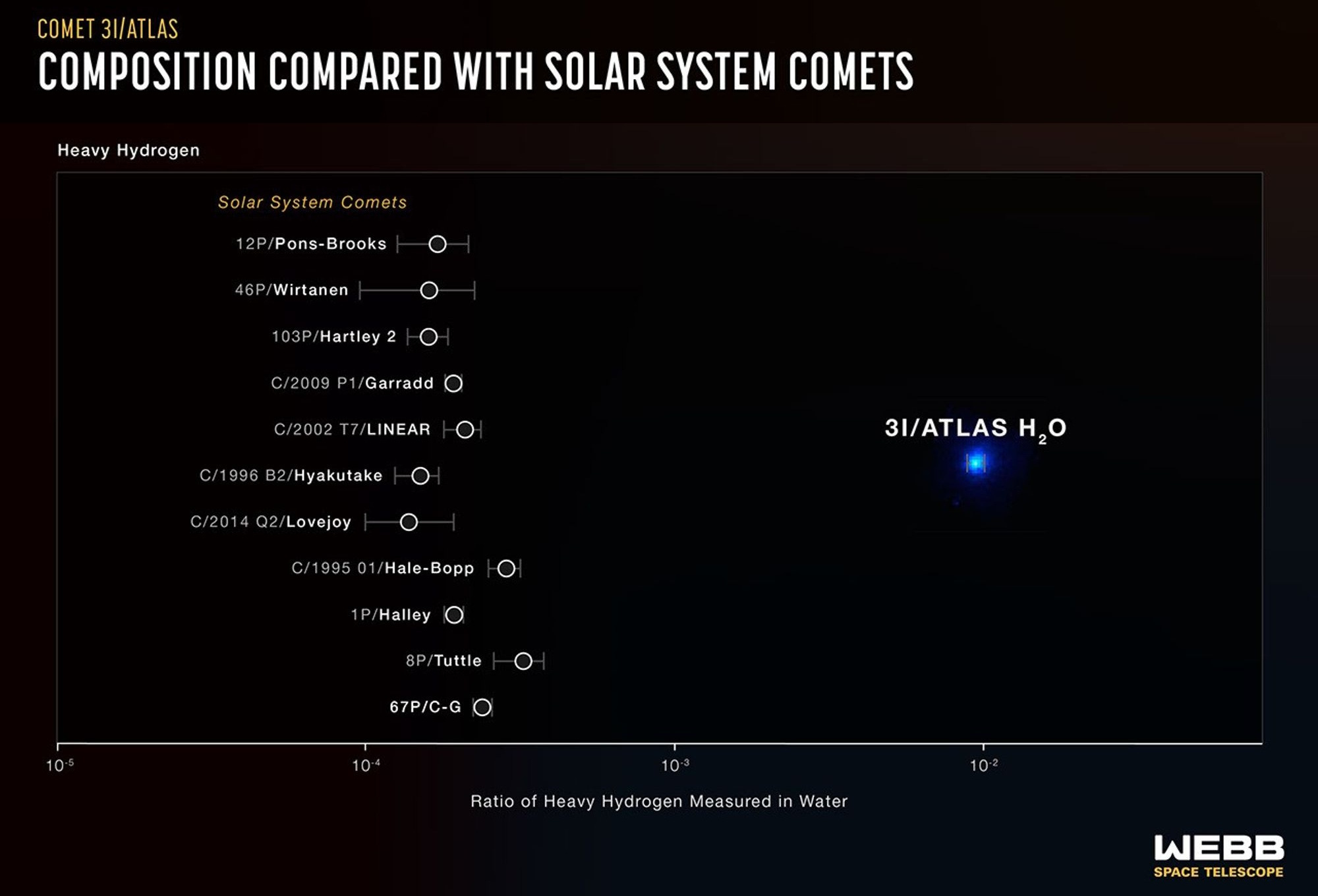
On its own, this not only suggests that 3I/ATLAS formed earlier on in cosmic history than our Solar System did, but much earlier: and in a much more pristine, unprocessed environment. The fact that deuterium is overrepresented so significantly, and overrepresented compared to anything we find within a few thousand light-years of our vicinity, suggests an origin from a vastly different environment than anything we find nearby. This “difference” can be inferred as not only a difference in space, but in time as well: to a much earlier epoch.
However, in addition to the evidence from:
3I/ATLAS’s trajectory, which doesn’t tell us very much on its own but is suggestive of an older age,
3I/ATLAS’s color, which is more compelling and suggests either an origin that’s older than our Solar System or suggests an excess of bombardment by cosmic rays for potentially other reasons,
and 3I/ATLAS’s deuterium abundance, which is wildly different than the deuterium abundance we find both in the Solar System and in nearby measurements of the interstellar medium,
there’s another key piece of evidence which is potentially the most decisive of all: evidence from carbon isotopes.
3.) Carbon
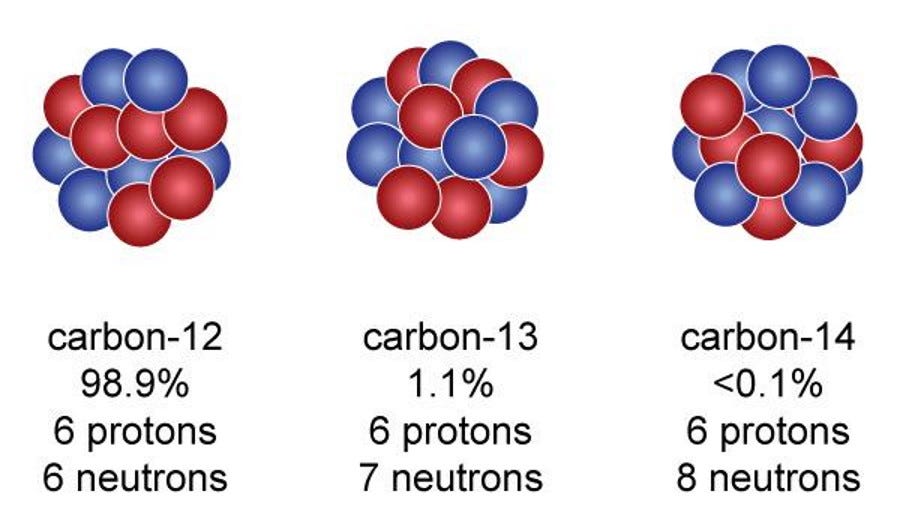
Here on Earth, just as is the case with hydrogen, there are three significant isotopes of carbon that naturally appear.
Carbon-12, with six protons and six neutrons, which is the primary form of carbon found all throughout the Universe.
Carbon-13, with six protons and seven neutrons, which is also a stable isotope of carbon and exists at about the 1.1% level here on Earth.
And carbon-14, with six protons and eight neutrons, which is largely produced here on Earth when cosmic rays strike our atmosphere, is incorporated into life forms that eat and breathe, and that radioactively decays (into nitrogen) with a half-life of around 5700 years.
While carbon-14 is insignificant in comets, asteroids, and interstellar bodies, the carbon-13 to carbon-12 ratio is a ratio that’s expected to increase over time. Models for galactic chemical evolution show that carbon-13 builds up slowly over time relative to carbon-12, where carbon is the fourth most abundant element in the Universe (behind hydrogen, helium, and oxygen). Although we can’t measure carbon directly as a monatomic atom very often, we can measure it in comets, asteroids, and active interstellar interlopers from its presence in molecules like carbon dioxide (CO2) and carbon monoxide (CO), as well as in nearby interstellar gas clouds and in protoplanetary disks.
If 3I/ATLAS really is older than the Solar System, there should be less carbon-13 relative to carbon-12 than there is here in our own backyard.
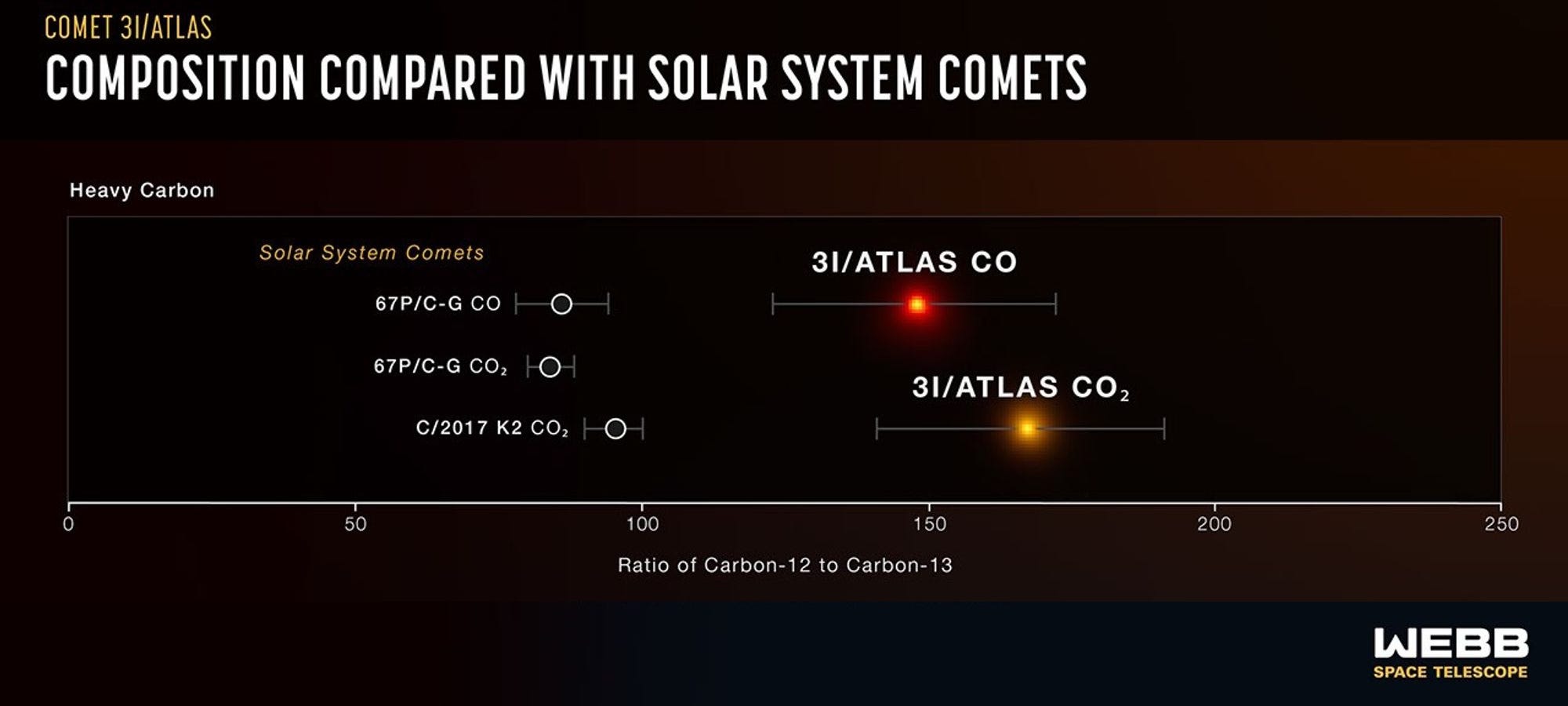
Indeed, that’s precisely what we find. Yes, carbon-12 is more abundant than carbon-13 across the board, but here on Earth, the ratio of carbon-12 to carbon-13 is about 90-to-1. In Solar System comets, such as classical comet 67P/Churyumov–Gerasimenko and Oort cloud comet C/2017 K2 (PanSTARRS), we find similar ratios: somewhere between 80-to-1 and 95-to-1, with relatively small error bars attached to them.
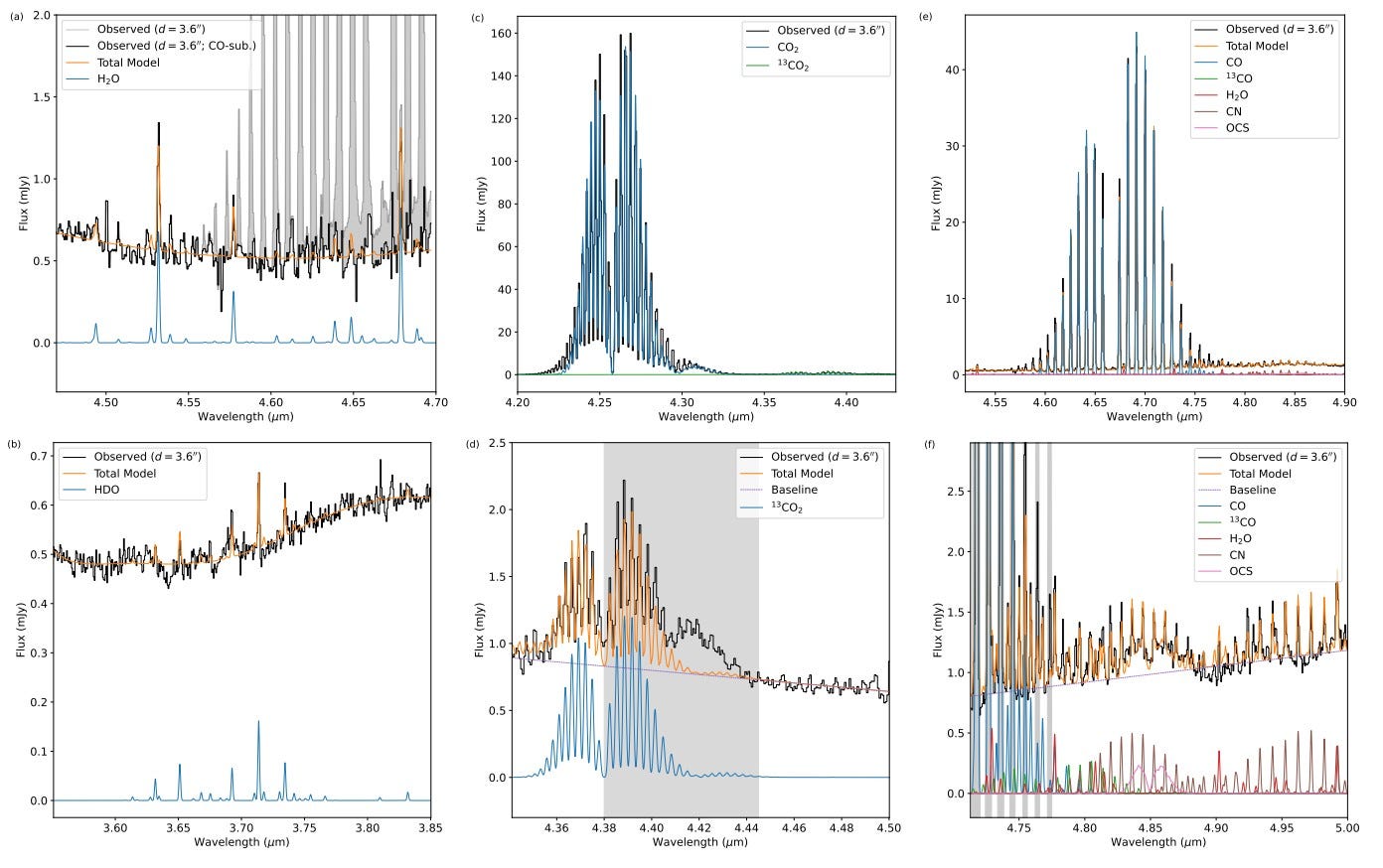
However, for comet 3I/ATLAS, as the new Nature study reveals, the carbon-12 to carbon-13 ratio is significantly higher, indicating that less carbon-13 formed relative to the amount of carbon-12 that formed. Specifically:
carbon monoxide (CO) abundances indicate a ratio of around 147-to-1, with the uncertainties supporting values ranging between 123-to-1 and 172-to-1,
while carbon dioxide (CO2) abundances indicate a ratio of around 166-to-1, with the uncertainties supporting values ranging between 141-to-1 and 191-to-1.
This exceeds typical values found within our Solar System, and also exceeds values found in nearby interstellar gas clouds and in nearby protoplanetary disks. When you fold in these latest results with the other lines of evidence, the conclusion becomes harder and harder to ignore: 3I/ATLAS is not only older than our own Solar System, but it’s likely much older than anything else we’ve experienced a close encounter with in recorded history.
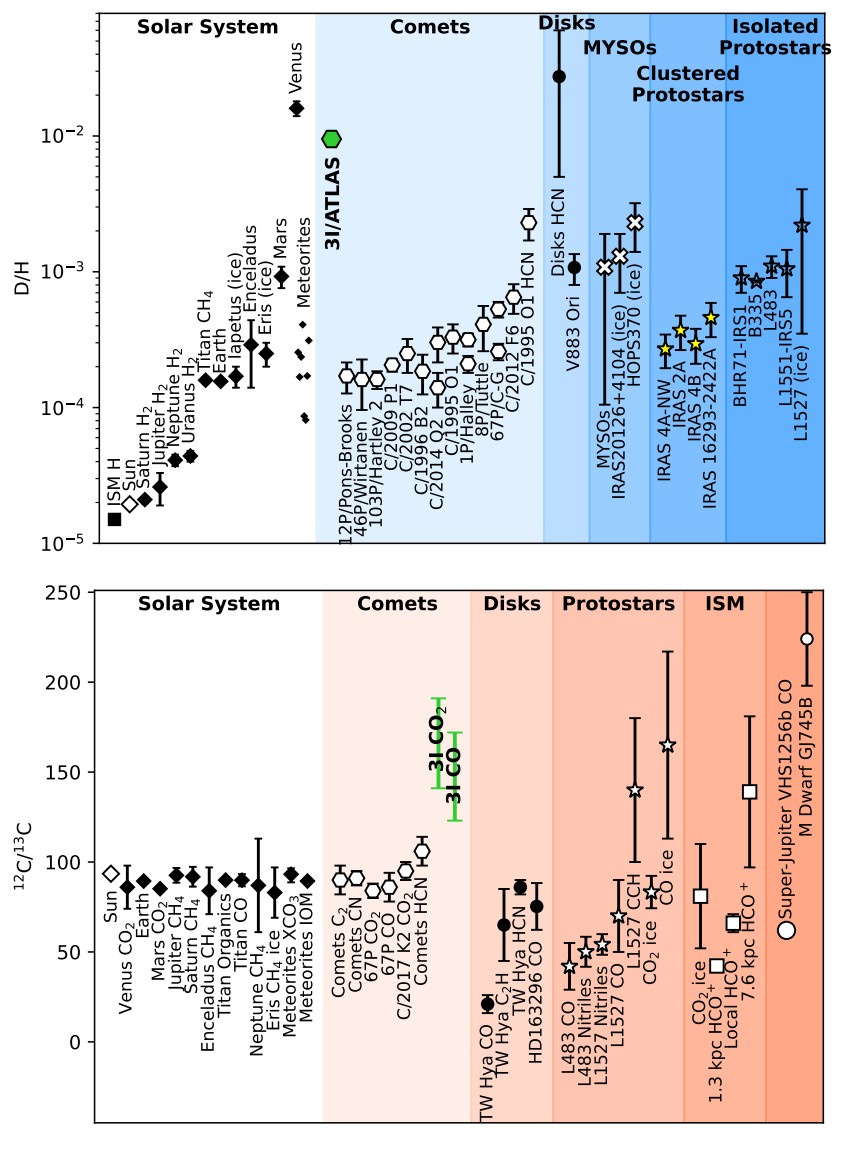
When you’re very far away from a star or newly-forming protostar, temperatures can remain low, even as you yourself are in the process of forming. As the authors of the Nature paper note, the strongly enhanced deuterium abundance favors a low-temperature formation scenario: at temperatures at or below 30 K; there must be minimal, at most, contamination from water that’s been re-processed at higher temperatures. Because it has a low abundance of carbon-13 relative to carbon-12 (presented as an elevated carbon-12 to carbon-13 ratio), the authors suggest that it likely accreted in a protoplanetary disk, long ago, far beyond the water-ice line, in a well-shielded area of the disk: likely the midplane.
This lines up with a scenario where, at some point near the peak of star-formation in our cosmic history — about 10-to-12 billion years ago — a new stellar system formed in an interstellar cloud that was being strongly irradiated by a whole swarm of new stars being born in the surrounding environment. Many species of molecules containing key elements that play a role in life on Earth, including carbon, oxygen, nitrogen, and sulfur, abound, with a reduced carbon-13 abundance but an enhanced deuterium abundance. Although we’ll certainly learn much more about these interstellar interlopers, as well as their nature, history, and diversity, as we uncover more and more of them, the fact is that we can already be certain that not only is 3I/ATLAS an object of interstellar origin, but that it’s the oldest object we’ve ever recorded here in our own Solar System, and that it’s billions, and likely several billions, of years older than anything else we’ve ever seen. The key evidence is written into the spectrum, both in terms of the color and the elements and isotopes found inside, of 3I/ATLAS itself.

Ethan Siegel, Ph.D., is an award-winning theoretical astrophysicist who's been writing Starts With a Bang since 2008. You can follow him on Twitter @StartsWithABang.
Get more from Big Think:
Big Think | Mini Philosophy | Big Think Books | Big Think Business